
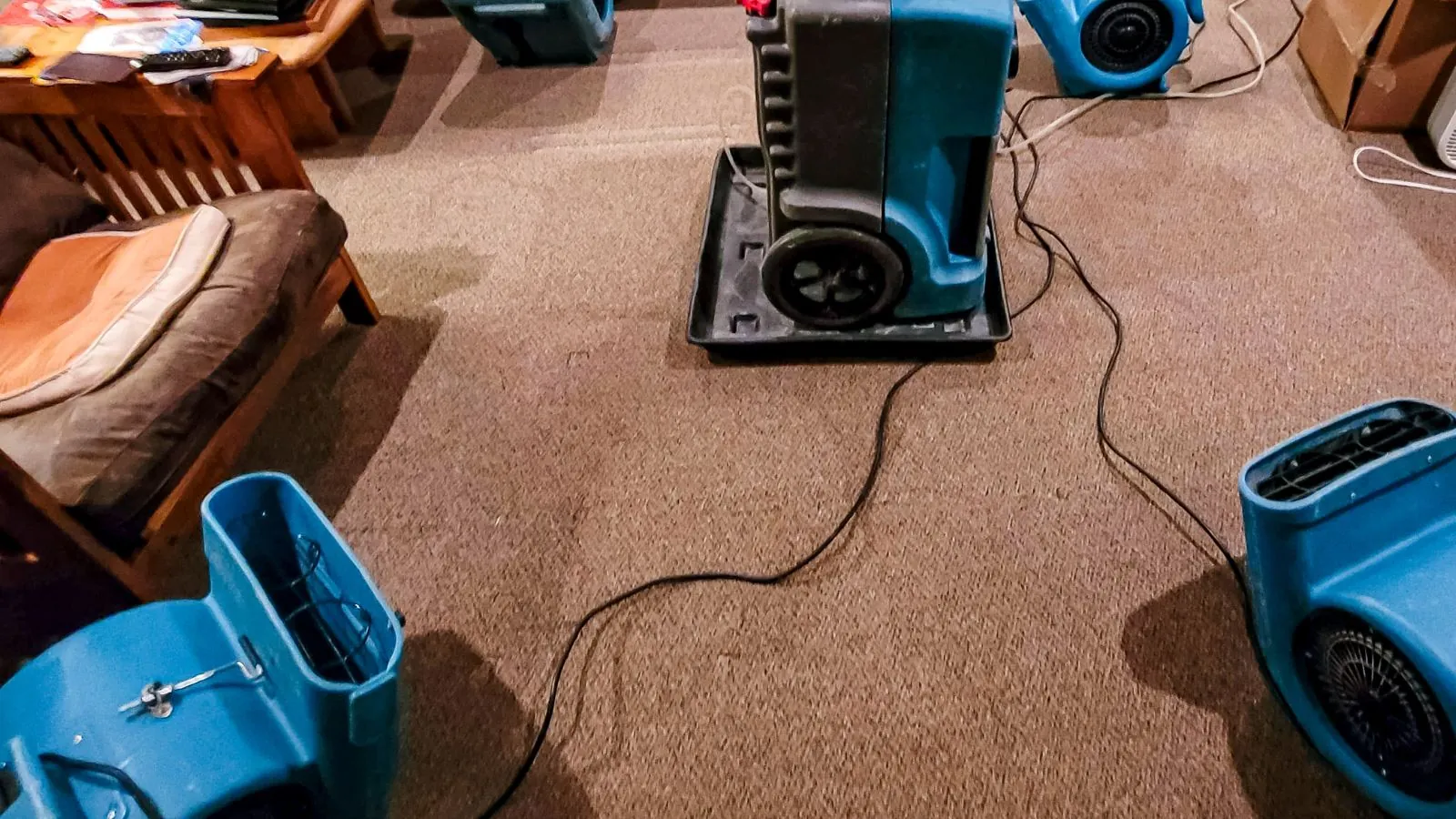
Walls and floors can look dry long after the surface moisture has gone, so crews use meters. The readings are not self-explanatory, though. A number that is normal in a basement slab may be too high for drywall. This article explains the two main types of meter, how to read results and what to ask if someone hands you a number.
You do not need to buy a meter to benefit from understanding one, but a basic pin meter can help you check suspicious spots between visits.
Two kinds of meter, two kinds of answers
Pin meters have two metal probes that press into the material. They read electrical resistance, which falls as moisture rises, and they give a number tied to the material tested. They are accurate on wood and can be used on drywall with the right scale.
Pinless meters sit against the surface and scan below it with an electromagnetic field. They are quick for scanning large areas and do not leave holes, but they read a relative value and are affected by metal behind the surface. Crews often use a pinless meter to find wet areas and a pin meter to confirm.
Meters at a glance
Each tool has a role.
| Tool | Best use | Limit |
|---|---|---|
| Pin meter | Confirming moisture in wood and some drywall | Leaves small holes, reads a small spot |
| Pinless meter | Scanning a wall or floor quickly | Relative values, affected by metal behind surfaces |
| Thermal camera | Finding cool, wet areas | Shows temperature, not moisture itself |
| Hygrometer | Air humidity in a room | Does not measure materials |
No single tool is enough. Crews combine them and compare wet areas with a dry reference spot.
Dry is relative: the reference reading
Dry drywall in a heated home reads differently from dry drywall in a damp basement. For that reason, a crew takes a reference reading in an unaffected part of the building, ideally of the same material. The target is to bring the wet material to that reference level.
Wood has a typical equilibrium range that depends on the humidity of the surrounding air. A floor that was acclimated to a humid summer will read higher than one in a winter heated home. Ask the crew what reference they used and where they took it.
What to ask when someone shows you a number
Ask which meter, which scale and which material. Ask where the reference reading was taken. Ask whether the number was the first, the daily or the final reading. A single high number does not mean disaster and a single low number does not mean safe, so look at the trend.
Ask to see the readings on a floor plan or a log. A crew that has a clear drying log can show each wet area becoming dry over days. That log is also useful for insurance.
Why surface dry is not dry
Drywall paper dries first, while the gypsum inside and the studs behind hold moisture. Baseboards trap water behind them. Subfloors under vinyl stay wet. Insulation keeps wetting the back of the board.
If you smell mustiness in a room that looks dry, a meter reading and sometimes a small inspection hole will tell you more than your eyes. The structural drying page explains how equipment brings those hidden areas to dry.
Reading a meter yourself: a short walk-through
If you own a pin meter, test a known dry spot first, such as an interior wall far from plumbing, and write the number down. Then test the suspect area at several heights, since moisture often climbs. Test at the baseboard, a foot up, and at waist height.
Repeat the readings at the same spots on the same days of the following week. A falling trend is a good sign. A flat or rising one means a source is still active or drying is incomplete.
Common mistakes with meters
Reading the surface of a painted wall and assuming the inside matches is one mistake. Pressing a pinless meter against a stud or a pipe and reading the metal is another. Comparing a reading on drywall to a scale for wood is a third.
Another is testing once. A single reading tells you little, because humidity changes through the day. Readings logged over several days give a picture. Photographs of the meter display next to the spot help keep records straight.
When a number should make you call someone
A reading far above your reference in a wall, a floor that keeps climbing or a spot that reads wet after you have fixed a leak are good reasons to call. So is a musty smell in a room where every reading looks fine, because the meter only reads where you put it.
A professional carries a thermal camera and larger meters, and can place the probe in hidden cavities. For water that is still entering, start with water extraction and call the 24/7 line.
Moisture content in different materials
Wood is measured as a percentage of its dry weight. Most interior wood sits in a range that reflects the humidity of the home. Drywall is often read on a relative scale, because it does not have a standard percentage in the same way. Concrete is tested with special meters or calcium chloride kits for flooring installation.
The practical lesson is that the same number means different things on different materials. Crews carry reference charts, and the best practice is to compare against a dry sample of the same material in the same building.
Keeping a simple moisture log at home
After any leak, pick three spots near the repair and one dry control spot. Record readings once a day for a week, then once a week for a month. Note the weather, the humidity and whether a dehumidifier was running.
This takes five minutes and gives you evidence that the wall is staying dry. If readings climb after a rain, the leak is not fully fixed.
Norton: basements and humidity
Norton's planning documents describe a low-lying town, and the Town's 2018 resilience workshop summary names flooded roads at Richardson Avenue, Walker Street and Route 123. In low-lying areas, basements tend to read more moisture in wet seasons. A meter baseline taken while the basement is dry gives you something to compare against later.
Using this with a pro
After a loss, ask the crew for readings on day one and the last day. If a leak came from above, check ceilings too, as explained under ceiling water damage repair. Crews also serve Mansfield and North Easton, with the same measurement habits.
What to do first, and what not to do
Testing a wet wall carries electrical and plumbing risks.
Safety steps
- Do not probe near live wiring or pipes
- Turn off power to a wet area before you test it
- Do not drill into a wall without checking for pipes
- Wear gloves when testing wet materials
Common questions
It depends on the material and the reference reading from an unaffected area. A crew compares wet and dry spots rather than using one fixed number.
A basic pin meter can help you check suspect spots. It is less reliable than professional gear, and it does not replace a drying log.
It shows cooler areas where evaporation is happening, which helps find hidden wet spots. It does not measure moisture on its own.
No promise can be made about mold. Mold needs moisture, so dry materials lower the risk.
Not specifically. A baseline reading in a damp basement is useful anywhere.
References for this article
Facts here come from the EPA mold and moisture pages, the Massachusetts Division of Insurance and the published ANSI/IICRC S500 and S520 standards. Your own policy and your town decide the details that apply to you.