
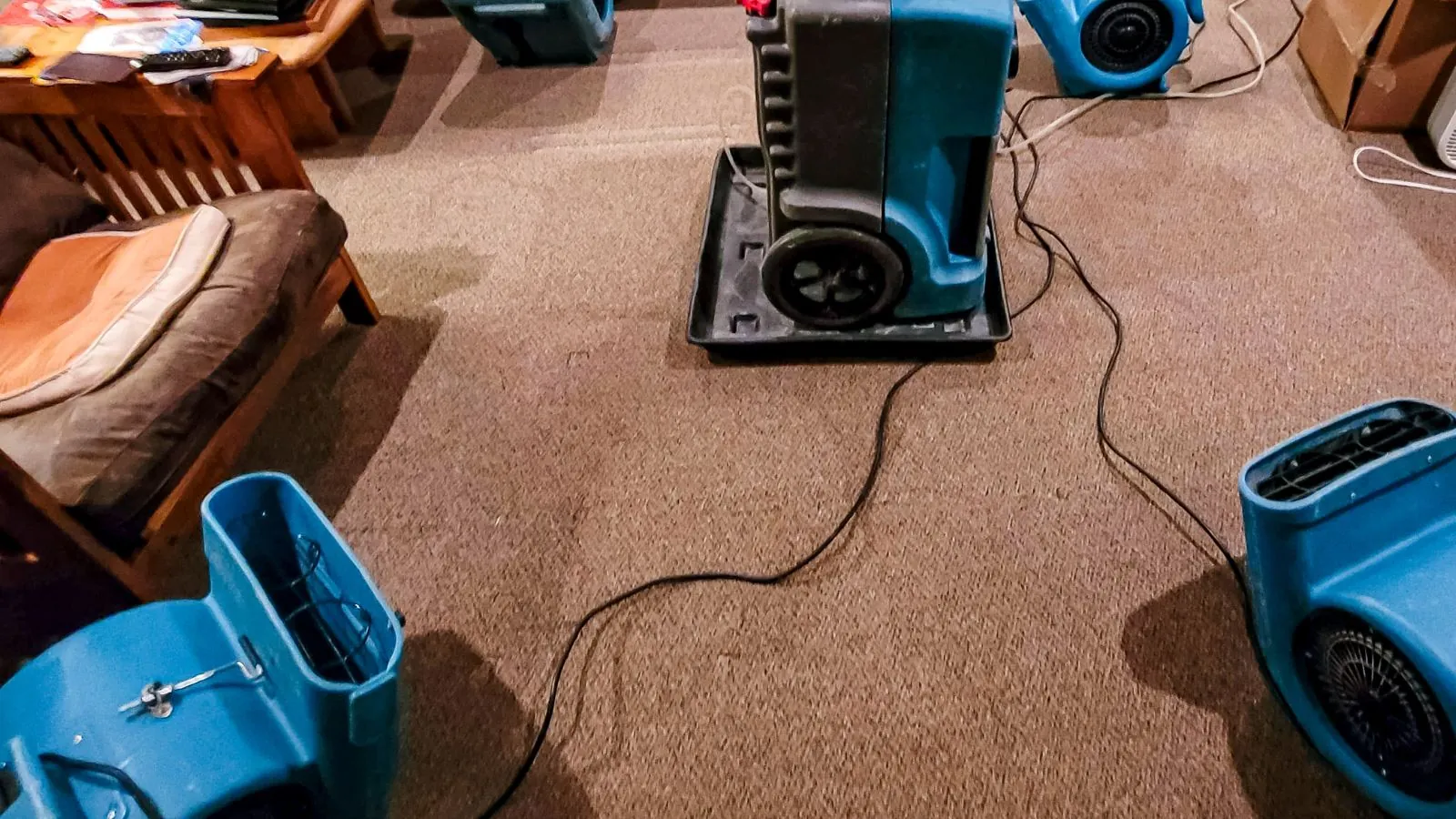
Homeowners want a number. The honest answer is a range, and what shifts it is the material, how much water got in and the conditions inside the house. This article gives typical timelines and explains what to expect on each visit.
These are general ranges, not promises. A moisture meter and a drying log are what tell you when your own structure is dry.
The short answer and what changes it
A typical structural drying job runs three to five days. Small spills in clean-water conditions can dry in two or three. Soaked concrete, thick framing and hardwood can take a week or more.
Five factors shift the timeline: the material, the volume of water, the starting moisture level, the temperature and humidity inside, and the amount of equipment working. A crew sizes equipment to the volume of the space, then adjusts.
Typical drying times by material
The table gives rough ranges that crews see. Your readings decide.
| Material | Typical range | Why |
|---|---|---|
| Carpet and pad | 1 to 3 days if dried promptly | Light and open to air |
| Drywall | 2 to 5 days | Absorbs quickly, releases moderately |
| Wood framing | 3 to 7 days | Slow to release |
| Hardwood flooring | 5 to 10 days or more | Dense and finished |
| Concrete slab | Several days to weeks | Holds moisture |
See structural drying for how equipment is placed and adjusted.
What a drying visit looks like
On day one the crew maps the moisture and sets equipment. On later days they return to take readings, move equipment and add or remove units. When every reading reaches the target, the equipment leaves.
If readings stall, they may open a wall cavity, add a dehumidifier or change the airflow. A job that never changes is a sign something is wrong.
Season and weather in Massachusetts
Cold, damp weather slows evaporation. Warm, dry air speeds it. In a New England winter, a heated home is usually drier than the outside air, which helps. In a humid summer, dehumidifiers must work harder.
Opening windows helps only when the air outside is drier than the air inside. Otherwise it adds moisture.
What speeds drying up
Fast extraction at the start removes the bulk of the water. Removing wet carpet pad, insulation and soaked drywall early cuts the time. Keeping doors to the wet rooms closed lets the equipment dehumidify only the affected space.
Call early. Water extraction within hours, rather than days, shortens everything that follows.
How a crew decides it is dry
The goal is not a single magic number. It is a set of readings that match the dry reference taken from an unaffected area. A crew checks each wet material against its reference and records the result. When every reading is at or near target, the equipment can come out.
Some jobs are declared dry on day three. Others take a week. Both can be correct. What matters is that the crew explains the targets and shows you the numbers.
What homeowners can do to help
Keep doors and windows closed in the drying zone so dehumidifiers work on the wet air, not the whole outdoors. Do not turn equipment off to save quiet. Do not move or unplug equipment without calling. Keep furniture off wet carpet and floors until the crew says it is safe.
Report anything that changes: a new stain, a new smell, a spot that feels cold or damp. These reports help the crew adjust the setup.
Signs drying has stalled
Readings that do not change after two days are a warning. So are rooms that feel warm and humid with equipment running, or equipment that cycles on and off with no progress. A good crew responds by opening cavities, adding units or changing the airflow.
If you suspect a stall, ask for the log. If you do not get one, ask why not. The drying record is the best protection against hidden problems later.
What drying looks like in specific rooms
In a kitchen, the toe-kicks come off and air is moved under the cabinets. In a basement, dehumidifiers run on the slab and block walls for days. In a bedroom with wet carpet, the pad comes out and air movers dry the carpet and the subfloor.
Each room has a different target time. Ask the crew for a room-by-room estimate and update it as readings come in.
Planning your life around the equipment
Equipment is noisy and warm. Plan to sleep in a quieter part of the house if possible. Ask the crew about power use, since several dehumidifiers and air movers draw real current on a household circuit. Ask which outlets they will use.
If you work from home, tell the crew which rooms you need. They can often stage the work so one area is quiet while another dries.
Drying after different kinds of loss
After a burst pipe in a kitchen, the typical plan runs three to five days with air movers and a dehumidifier. After a basement flood, the plan may run a week because concrete holds water. After a ceiling leak, drying the cavity above the ceiling may take three to four days. After a sewage loss, cleaning comes first and drying follows.
These are ranges, not promises. Ask the crew for a target date and what could move it, then check the log.
Questions to ask on day one
Ask which rooms will get equipment, how many units, how often readings are taken and when the crew expects each room to be dry. Ask who to call if a unit stops or trips a breaker. Ask whether any materials will need to be removed and how that decision will be made.
Writing the answers down gives you something to compare against on day three. If the plan changes, you will know why.
Key points to remember
Most structural drying takes about three to five days, with concrete, hardwood and cold weather stretching it. Start fast, remove what cannot dry and let the equipment run until readings match a dry reference. Ask for the log and keep it with your insurance records. If progress stalls, ask the crew what they will change. A clear explanation each day is a sign the job is under control.
A Norton note
The Town of Norton's 2018 resilience workshop summary describes much of the town as low-lying and names flooded roads at Richardson Avenue, Walker Street and Route 123. In low-lying areas, basements can start wetter and dry slower, so plan for a longer drying time for slabs after heavy rain. Check the FEMA flood map and ask the Norton building department about drainage.
Related pages
Floors dry on their own schedule, and hardwood floor water damage repair explains why. Crews work across South Easton and Mansfield too.
What to do first, and what not to do
What you do while the equipment runs affects how fast the structure dries.
Safety steps
- Keep doors closed to the wet rooms while equipment runs
- Do not unplug or move equipment without asking
- Do not paint or cover walls until readings are dry
- Report new smells or stains to the crew
Common questions
Often two to five days, depending on how wet it was. A meter confirms.
A household fan helps the surface only. Commercial dehumidifiers and air movers dry cavities.
It holds water and releases it slowly, so slab readings are checked on each visit.
Usually replaced, since it holds water and does not insulate when wet.
After readings show the materials are dry, typically a few days to a week or more.
References for this article
Read more at the EPA and the Massachusetts Division of Insurance. The ANSI/IICRC S500 and S520 standards describe how professionals handle water and mold. Verify anything that depends on your policy or your address.